The Federal Record Behind the Street Narrative

🟥 Dion “Booquan” Nelson pictured in Arlington.
📂 The Federal Investigation
Arlington, Staten Island, NY — Before the YouTube storytelling.
Before the Instagram narratives.
Before today’s image control.
There is the federal record.
In a sentencing submission filed by the United States Attorney’s Office for the Eastern District of New York, Dion Nelson is described as a leader of a crew operating in Arlington and Mariners Harbor — a crew tied to Bloods street gang activity and narcotics distribution.
According to prosecutors, that crew:
• Distributed cocaine and marijuana
• Maintained stash locations
• Possessed and discharged firearms
• Engaged in violent disputes with rival sets
That description comes from the government’s own filing to the court.
🏠 The Stash House — 55 Holland Avenue
On September 18, 2009, NYPD executed a search warrant at 55 Holland Avenue, Apartment 9K in Arlington.
Recovered, according to the sentencing memo:
• Multiple loaded firearms
• Bulletproof vests
• Cocaine, crack cocaine, marijuana
• Ammunition and shell casings
After his arrest, Nelson waived his Miranda rights.
The memo states he admitted:
• The guns were his
• The drugs were his
• He paid the rent so he could use the apartment as a stash house
That is documented in the federal record.
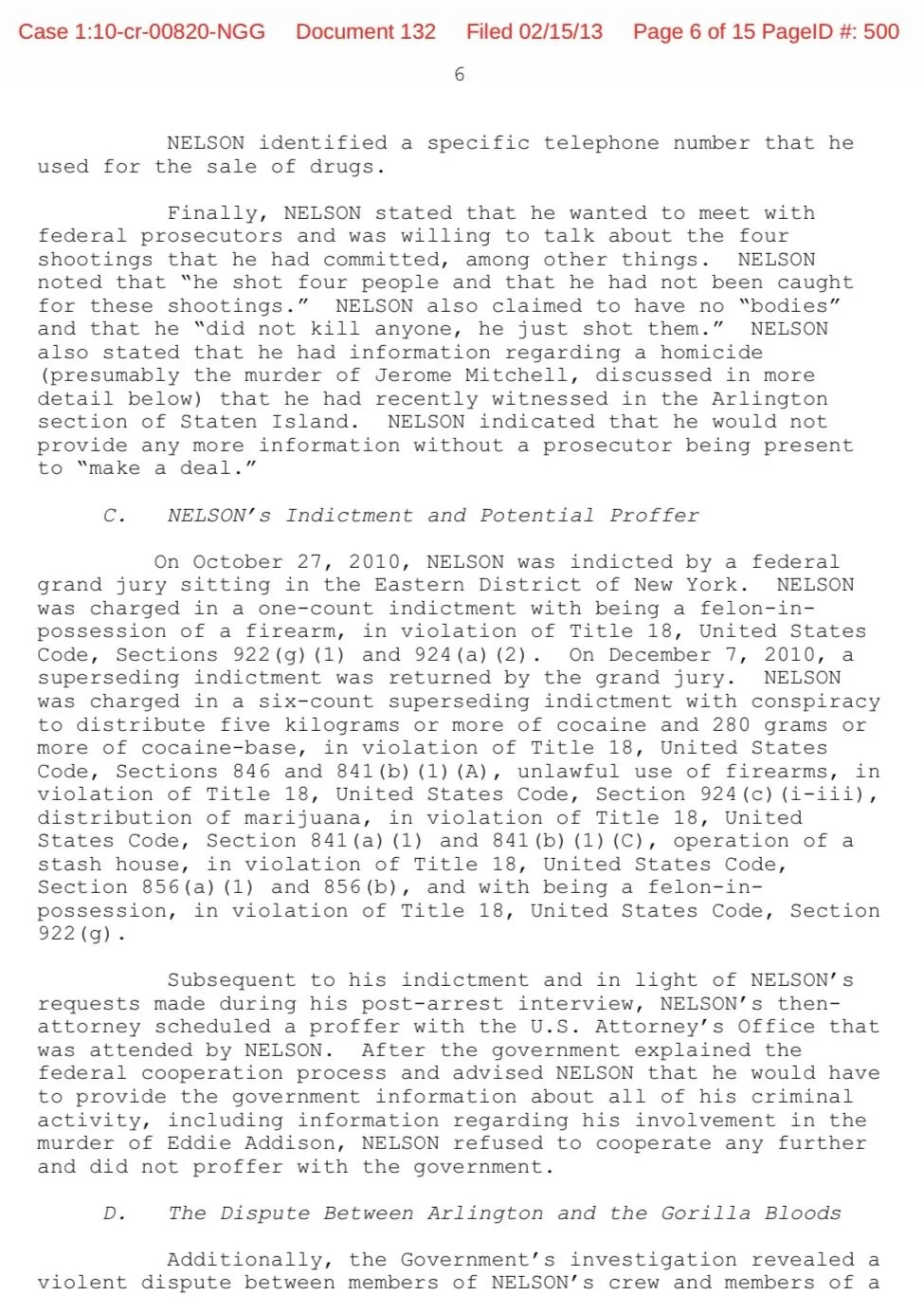
📄 Page 6 of the federal sentencing memo detailing Nelson’s post-arrest statements.
🫱🏻🫲🏽 The “Make a Deal” Statement
According to Page 6 of the sentencing memo, Nelson told agents he wanted to meet with federal prosecutors and was willing to talk about four shootings he had committed.
The filing states he said:
• He shot four people
• He had not been caught
• He had no “bodies”
• He had information regarding a homicide
• He would not provide further information without a prosecutor present to “make a deal”
That language appears in the court document.
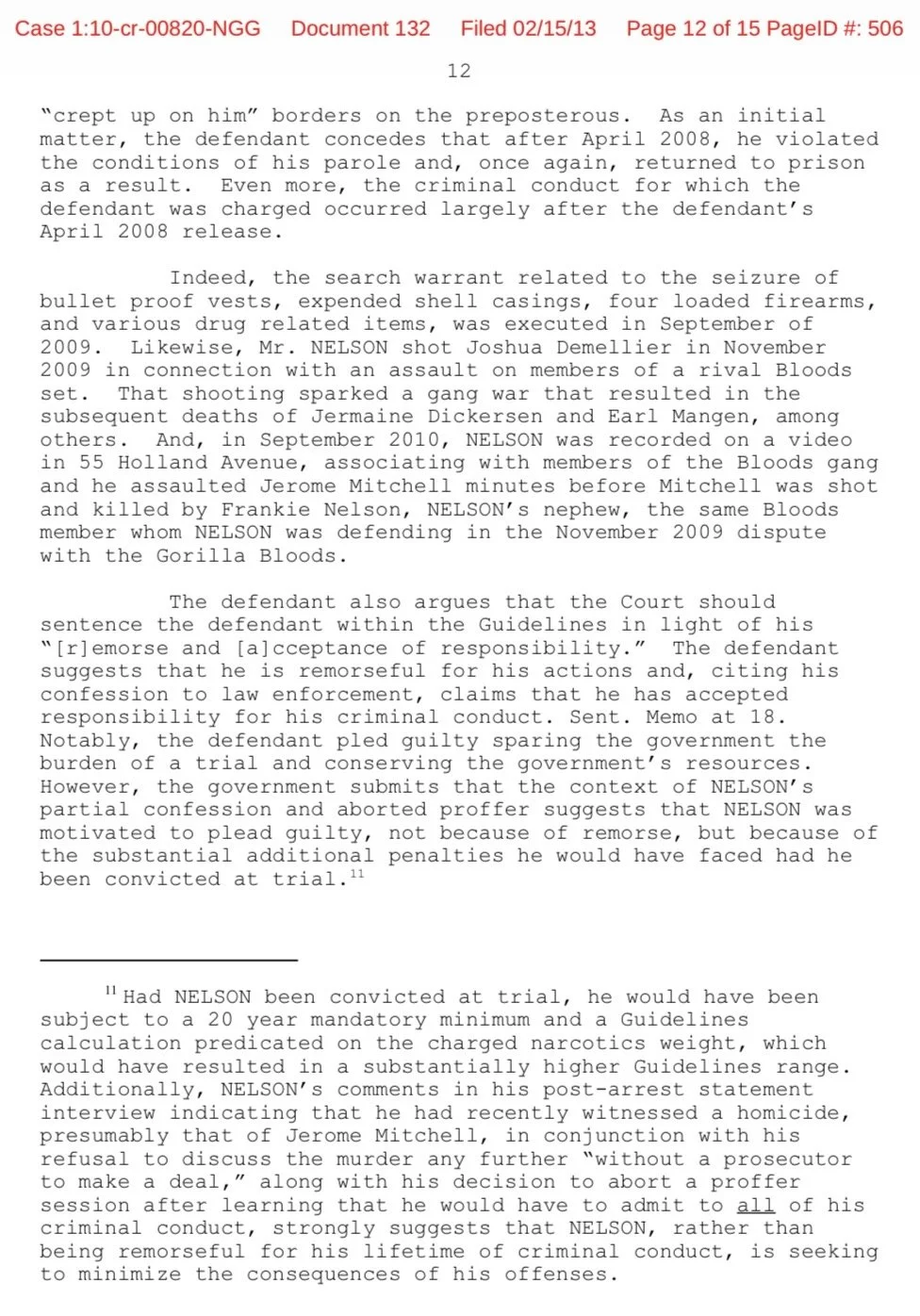
📑 Federal filing stating Nelson attended a proffer session and declined to continue.
📝 The Proffer Session
After his indictment, a proffer session was scheduled with the U.S. Attorney’s Office.
The sentencing memo states that Nelson attended.
According to the filing, prosecutors explained that federal cooperation requires full disclosure of all criminal activity — including information regarding the murder of Eddie Addison.
The memo states that Nelson refused to cooperate further and did not complete the proffer.
The government later referred to this sequence as a “partial confession and aborted proffer.”
That phrasing comes directly from the sentencing submission.
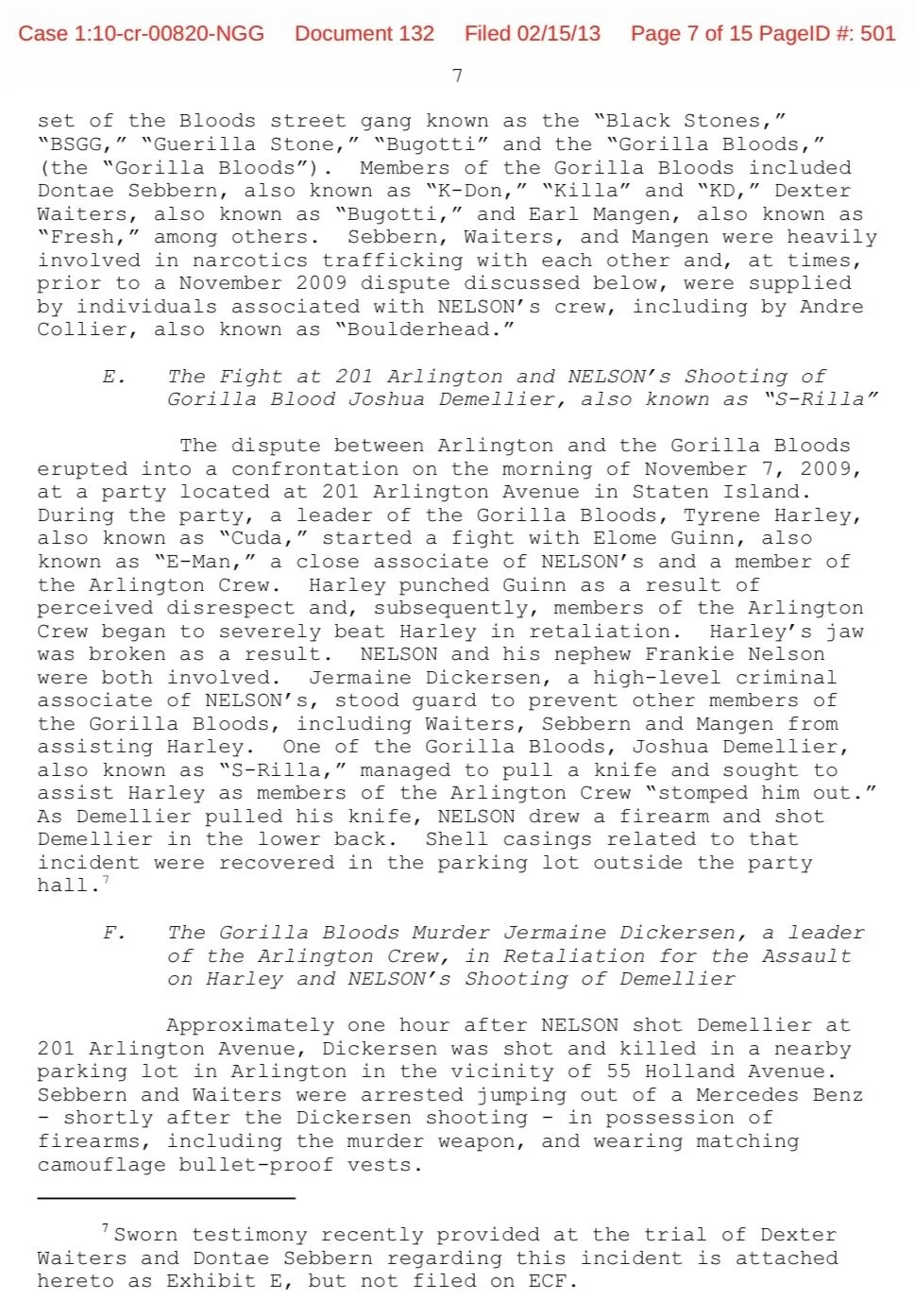
🔎 Page 7 of the sentencing memo describing the November 7, 2009 shooting.
🔫 The Shooting That Escalated the Conflict
The memo also confirms that on November 7, 2009, during a confrontation between members of the Arlington crew and the Gorilla Bloods, Nelson drew a firearm and shot Joshua “S-Rilla” Demellier in the lower back.
Prosecutors argue that incident sparked retaliatory violence that led to multiple subsequent deaths, including Jermaine “Big Den” Dickerson.
That is the government’s framing of the chain of events.
🧱 The Code Where We Come From
Let’s separate law from culture.
In federal court, “cooperation” has a formal definition — signed agreements, courtroom testimony, 5K1.1 motions.
In the streets, the definition is broader.
Where we come from, when you get arrested, there is one rule:
You shut your mouth.
You ask for a lawyer.
You do not start discussing shootings.
You do not volunteer that you “shot four people.”
You do not tell agents you have information about a homicide.
You do not ask to “make a deal.”
According to the sentencing memo, Nelson did all of those things.
He initiated conversation about cooperation.
He expressed willingness to talk about multiple shootings.
He indicated he had information regarding other crimes.
He asked to meet prosecutors to negotiate.
A proffer session was then scheduled — and he attended.
The memo states that once prosecutors explained he would need to disclose all criminal conduct, he refused to continue and did not complete the proffer.
The government described the situation as a “partial confession and aborted proffer.”
Now here’s where interpretation splits.
There are different forms of cooperation.
Some people take the stand.
Some wear wires.
Some participate in stings.
Some sign formal agreements.
Some sit down in proffer sessions and begin negotiating information.
Legally, those categories are distinct.
Culturally, in many neighborhoods, the line is drawn earlier.
For some, the moment you begin negotiating information about other crimes in exchange for consideration — you’ve crossed it.
Others define it differently.
The federal record reflects what occurred.
How it is judged depends on the code you live by.
⚖️ The Guilty Plea
Nelson ultimately pled guilty to discharging a firearm in furtherance of drug trafficking under federal law.
The mandatory minimum sentence was 120 months.
The government recommended 264 months, arguing that his conduct and criminal history warranted a substantially higher sentence.
🧠 Image vs. Record
Street narratives are loud.
Social media reinvents reputations.
But court filings are permanent.
The record reflects:
• Leadership allegations
• Narcotics trafficking
• Firearm discharge
• An expressed willingness to “make a deal”
• Attendance at a proffer session
• An aborted cooperation process
Those are documented facts.
The interpretation — that’s cultural.
Not for clicks — for clarity.
— Elliott Carterr, LFTG Radio
📱 TikTok: @elliott_carterr ↗
📺 YouTube: @lftgradio ↗
🌐 Website: LFTGRadio.com ↗
⚖️ The Gutter Justice Project ↗
❤️ Support the work: LFTGRadio.com/donate ↗
